
250 Years of Hudson County
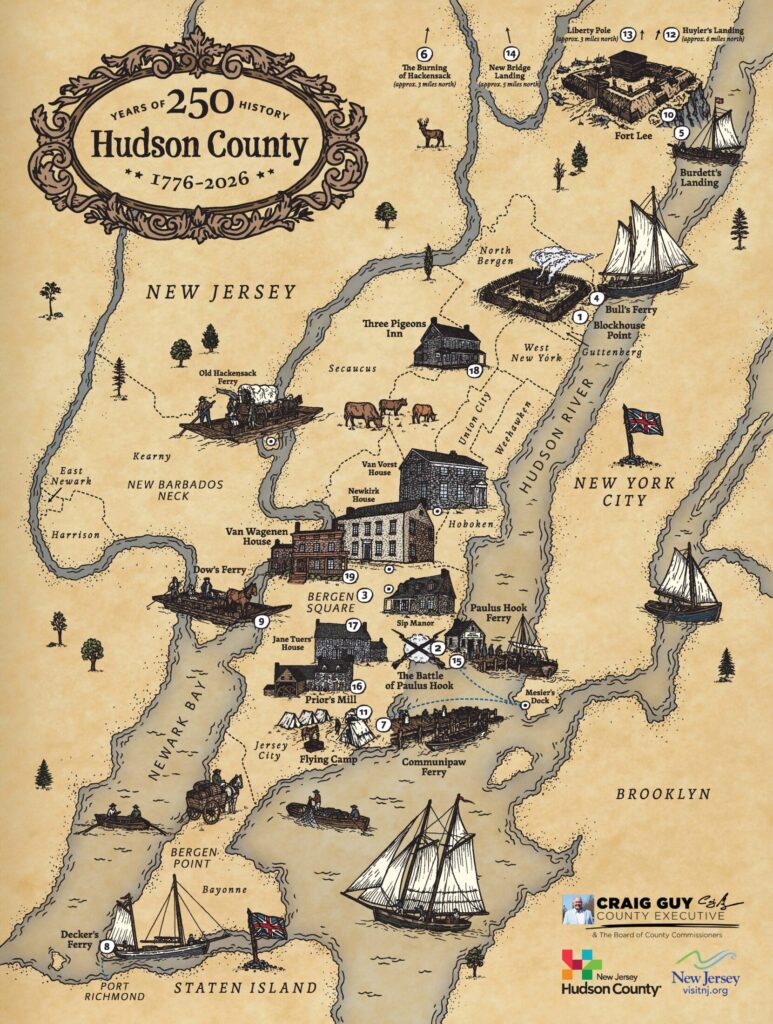
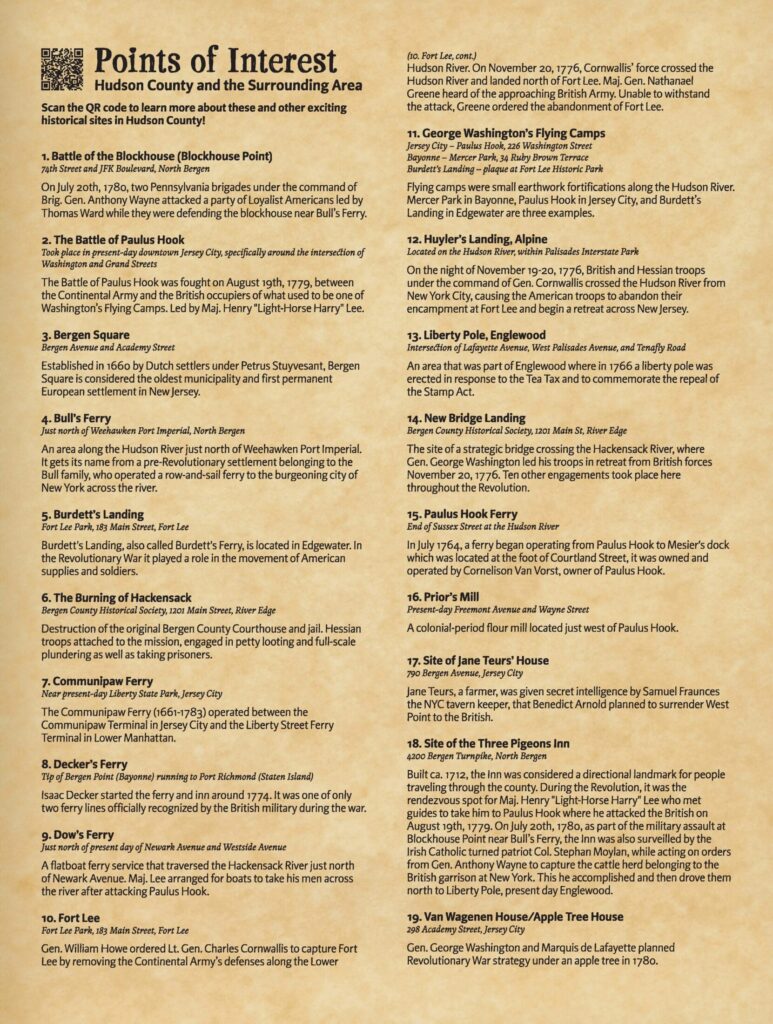
battle of the blockhouse
(blockhouse point)
74th Street and JFK Boulevard, North Bergen
On July 20th, 1780, two Pennsylvania brigades under the command of Brigadier General Anthony Wayne attacked a party of Loyalist Americans led by Thomas Ward while they were defending the blockhouse near Bull’s Ferry. The Americans stormed the blockhouse, which was unassailable, when ordered to retreat, the Pennsylvanians pressed forward losing 70 combatants and failing to take the position.
The Battle of Paulus Hook
Took place in present-day downtown Jersey City, specifically around the intersection of Washington and Grand Streets
The Battle of Paulus Hook was fought on August 19th, 1779, between the Continental Army and the British occupiers of what used to be one of Washington’s Flying Camps. Led by Maj. Henry “Light-Horse Harry” Lee.
bergen square
Bergen Avenue and Academy Street
Established in 1660 by Dutch settlers under Petrus Stuyvesant, Bergen Square is considered the oldest municipality and first permanent European settlement in New Jersey.
bull's ferry
Just north of Weehawken Port Imperial, North Bergen
An area along the Hudson River just north of Weehawken Port Imperial. It gets its name from a pre-Revolutionary settlement belonging to the Bull family, who operated a row-and-sail ferry to the burgeoning city of New York across the river.
burdett's landing
Fort Lee Park, 183 Main Street, Fort Lee
Burdette was a New York merchant who bought 400 acres near Edgewater in 1756 and founded a trading post and ferry service, transporting goods and people on the Hudson River from New Jersey across to New York.
the burning of hackensack
Bergen County Historical Society, 1201 Main Street, River Edge
Destruction of the original Bergen County Courthouse and jail. Hessian troops attached to the mission engaged in petty looting and full-scale plundering as well as taking prisoners
communipaw ferry
Near present-day Liberty State Park, Jersey City
The Communipaw Ferry was a historic 17th century, colonial era ferry connecting the village of Communipaw on the Western bank of the Hudson to Lower Manhattan, it was officially chartered in 1661 and was one of the first ferry services across the Hudson River.
decker's ferry
Tip of Bergen Point (Bayonne) running to Port Richmond (Staten Island)
Isaac Decker started the ferry and inn around 1774. It was only two ferry lines officially recognized by the British military during the war.
dow's ferry
Just north of present day Newark Avenue and Westside Avenue
A flatboat ferry service that traversed the Hackensack River just North of Newark Ave. Major Lee arranged for boats to take his men across the river after attacking Paulus Hook. However, they were not there when he arrived, forcing his party and their 158 prisoners to walk the 14 miles back to New Bridge Landing.
fort lee
Fort Lee Park, 183 Ma Street, Fort Lee
Gen. William Howe ordered Lt. Gen. Charles Cornwallis to capture Fort Lee by removing the Continental Army’s defenses along the Lower Hudson River. On November 20, 1776, Cornwallis’ force crossed the Hudson River and Landed North of Fort Lee. Maj. Gen. Nathanael Green heard of the approaching British army. Unable to withstand the attack, Greene ordered the abandonment of Fort Lee.
george washington's flying camps
Jersey City – Paulus Hook, 226 Washington Street
Bayonne – Mercer Park, 34 Ruby Brown Terrace
Burdett’s Landing – Plaque at Fort Lee Historic Park
Flying camps, also known as redouts, were small earthwork fortifications along the Hudson River. Mercer Park in Bayonne, Paulus Hook, in Jersey City, and Burdett’s Landing are just three examples. These camps were manned by Virginia and Maryland regulars under the command of Hugh Mercer.
huyler's landing, alpine
Located on the Hudson River, within Palisades Interstate Park
Cornwallis’ army landed at this spot in pursuit of the Continental Army which was retreating through New Jersey.
liberty pole, englewood
Intersection of Lafayette Avenue, West Palisades Avnue, and Tenafly Road
An area that was part of Englewood where in 1766 a liberty pole was erected in response to the Tea Tax and to commemorate the repeal of the Stamp Act.
new bridge landing
Bergen County Historical Society, 1201 Main St, River Edge
The site of a strategic bridge crossing the Hackensack River, where General George Washington led his troops in retreat from British forces November 20, 1776. Ten other engagements took place here throughout the Revolution.
paulus hook ferry
End of Sussex Street at the Hudson River
In July 1764, a ferry began operating from Paulus Hook to Mesier’s dock which was located at the foot of Courtland Street, it was owned and operated by Cornelison Van Vorst, owner of Paulus Hook.
prior's mill
Present-day Freemont Avenue and Wayne Street
A colonial-period flour mill located just west of Paulus Hook
Site of jane teurs' house
790 Bergen Avenue, Jersey City
The Teurs house was situated within the boundaries of Bergen Square. Its most important resident was Jane Teurs a farmer who was given secret intelligence by Samuel Fraunces the tavern keeper, while she was selling him vegetables in British held New York. She learned from him that he overheard two British officers discussing Benedict Arnold’s plan to surrender West Point to them. Through her brother, Teurs got a message to Washington informing him of Arnold’s calumny. It is because of Jane that the Revolution was saved.
site of the three pigeons inn
4200 Bergen Turnpike, North Bergen
The Inn was considered a directional landmark for people traveling through the county. During the Revolution, it was the rendezvous spot for Colonel Henry “Light Horse Harry” Lee who met guides to take him to Paulus Hook where he attacked the British on August 19th, 1779. On July 20th, 1780, as part of the military assault at Blockhouse Point near Bull’s Ferry, the Inn was also surveilled by the Irish Catholic turned patriot Col. Stephan Moylan, while acting on orders from Gen. Anthony Wayne to capture the cattle heard belonging to the British garrison at New York. This he accomplished and then drove them North to Liberty Pole, present day Englewood.
Van Wagenen House/ Apple Tree House
298 Academy Street, Jersey City
Gen. George Washington and Marquis de Lafayette planned Revolutionary War strategy under an apple tree in 1779.